Shop Now
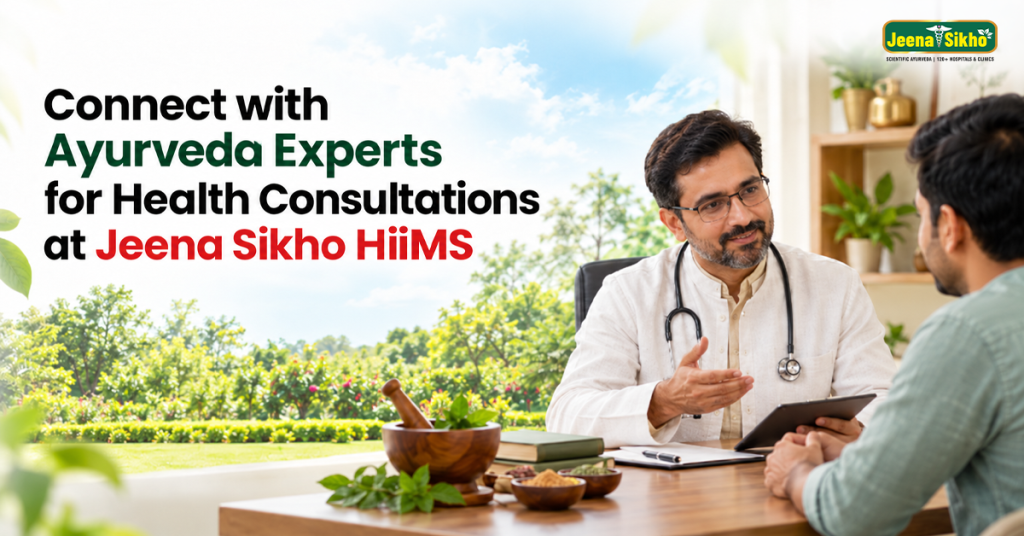

Starting Ayurveda is easier when someone guides you. Whether you are dealing with a long-term condition or just want to understand your digestion, sleep or energy better, talking to Ayurveda experts gives you a plan built around you, not a generic list of herbs.
In this blog, we explain how an Ayurvedic consultation works, what to expect at your first visit, which conditions and therapies Jeena Sikho HiiMS covers, and how video OPD (VOPD) helps if you cannot travel.
What is an Ayurvedic Health Consultation?
An Ayurvedic health consultation is a detailed one-to-one talk where the doctor looks at your whole health, not just the complaint you came with. They ask about digestion, sleep, stress, food and daily routine, and they check your pulse and body. The goal is to understand your prakriti, or body constitution.
A 2025 review in Frontiers in Medicine calls prakriti the foundation of personalised care in Ayurveda. It also notes that prakriti has traditionally been judged by experience and can be subjective, and it counts 64 assessment tools developed between 1987 and 2024. That is why good Ayurveda experts combine it with your reports and history.
Want to talk to a doctor about your health? Book a consultation with Jeena Sikho HiiMS.
Why See an Ayurvedic Doctor Instead of Self-Treating?
Many people already use traditional medicine. WHO’s Global Report on Traditional and Complementary Medicine 2019 draws on 179 member states, and 170 of them (88%) reported using it.
Herbs and therapies are not one-size-fits-all. A qualified Ayurvedic doctor checks your condition, your current medicines and whether a therapy suits you. This matters most if you already take tablets for diabetes, blood pressure or thyroid. The doctor can also tell you when you need tests or a specialist alongside Ayurveda.
What to Expect in an Ayurveda Doctor Consultation
Here is how a first visit usually goes:
- Your health history: the main complaint, past illnesses, medicines and family history
- Questions about digestion, sleep, appetite, stress and routine
- A pulse and physical examination
- A review of your lab reports and scans
- A plan covering diet, herbs, therapies and yoga
- Follow-up visits to adjust the plan
Bring your old reports and a list of current medicines. At Jeena Sikho HiiMS, patients often tell us the longest part of the first visit is the questions about sleep and food, not the examination.
A good Ayurveda doctor consultation ends with you understanding the plan. Ayurveda experts should explain each step in plain language, so you know why a diet or therapy is suggested.
Conditions and Therapies at Jeena Sikho HiiMS
Jeena Sikho HiiMS (Hospital & Institute of Integrated Medical Sciences) offers Ayurveda, Panchakarma, naturopathy, homeopathy and diet-based care. Our patient videos list conditions such as kidney, liver, heart and stomach problems, diabetes, high blood pressure, thyroid, asthma, PCOD/PCOS, obesity, skin disorders, arthritis and cancer support. The Ayurveda experts at HiiMS plan therapies by condition. Some examples:
- Kidney disease: Hot Water Immersion (HWI) therapy, Head Down Tilt (HDT) therapy, a DIP diet and Panchakarma, as HiiMS describes in its kidney patient video.
- Asthma: The CAAT Protocol, Panchakarma, and yoga and pranayam for breathing support.
- Cancer (supportive care): Golden Therapy, Cancer Detox Juice and diet planning, alongside your oncologist’s treatment.
- Thyroid: Diet and lifestyle guidance, Panchakarma and herbal support for thyroid imbalance.
- Diabetes, blood pressure, liver, gut and heart: Diet planning, Panchakarma, naturopathy and yoga, as advised by the doctor.
Therapies depend on your reports and condition.
Choosing the Best Ayurvedic Hospital for You
No list can name the best Ayurvedic hospital for your condition, so look at a few practical things. Check that the doctors are qualified and registered. See whether they review your reports and ask about your current medicines. Ask for the plan and costs in advance, and whether they are open to working with your regular doctor. Do not hesitate to ask the Ayurveda experts at any centre these questions.
HiiMS has more than 120 hospitals, clinics and day care centres and over 900 Ayurvedic doctors. It also states that Ayushman and Arogya Sanjeevani insurance are accepted at its hospitals. Please confirm your eligibility with the centre before admission.
VOPD and OPD: Two Ways to Consult
If you live near a HiiMS centre, an OPD visit lets the doctor examine you in person. If you are far away or travel is difficult, a video OPD (VOPD) lets you share your problem, reports and medicines over a video call.
A video Ayurvedic health consultation works best when you keep your reports ready, sit in good light and note down your questions beforehand. Many people start with VOPD and visit the centre if the doctor advises it.
Prefer to talk from home? Book a video OPD with Jeena Sikho HiiMS on 82704-82704.
Patient Experiences Shared on Video
Hearing from other patients helps many people decide. HiiMS has shared a few stories on YouTube. In this video, a patient shares their review of the HiiMS kidney care programme.
In another video, a family talks about their son’s experience of following the diet plan advised by Acharya Manish Ji after a cancer diagnosis.
These are personal experiences, and results vary from person to person, so please treat them as information rather than a promise. Ask the Ayurveda experts at HiiMS how a plan would apply to your own case.
Conclusion
A good consultation is less about a quick prescription and more about being heard, examined and given a plan you understand. Ayurveda experts can help you with diet, therapies and routine, while your regular medicines and tests continue as advised.
If a health problem has been with you for a while, speaking to an ayurvedic doctor and sharing your reports is a sensible next step. Book your VOPD with Jeena Sikho HiiMS today.
FAQs
1. Which conditions can I consult for at Jeena Sikho HiiMS?
These include kidney, liver, heart, diabetes, blood pressure, thyroid, asthma, PCOD/PCOS, skin and joint problems, and supportive care in cancer.
2. Can I consult online?
Yes, through video OPD (VOPD), which is useful if you live far from a centre.
3. Should I stop my current medicines?
No. Never stop prescribed medicines on your own. Tell the doctor what you take so the plan fits around it.
4. What should I carry to the first visit?
Your old reports, prescriptions and a list of current medicines.
5. Is health insurance accepted?
HiiMS states that Ayushman and Arogya Sanjeevani are accepted. Confirm with your nearest centre.